Lesson 2: MAN & DQDB Topology 🌆
Metropolitan Area Network (MAN)
A MAN (Metropolitan Area Network) connects multiple LANs across a city or large campus. It bridges small-scale LANs and wide-scale WANs.
Typical MAN technologies include fiber optics, microwave links, and high-speed switches.
One of the most important MAN structures is DQDB (Distributed Queue Dual Bus).
🧩 DQDB — Distributed Queue Dual Bus
🌐 Overview
DQDB is a dual-bus topology used in MANs for high-speed data communication. It was standardized under IEEE 802.6.
It consists of two unidirectional buses (fibers) running in opposite directions:
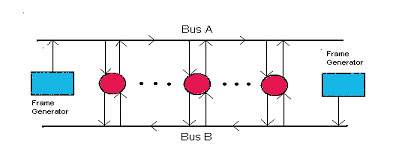
Each device connects to both buses:
- On the top bus, it receives from the left and sends to the right.
- On the bottom bus, it receives from the right and sends to the left.
At each end of the buses:
- Left of the top bus → 🟢 Empty Cell Generator 1 (creates empty cells repeatedly)
- Right of the bottom bus → 🟢 Empty Cell Generator 2
⚙️ How It Works
-
Empty Cells Flow Continuously: Empty cells are generated and move along the bus. These are like data containers waiting to be filled.
-
Station A (first station) has priority access to the top bus since it receives empty cells first.
-
When Station A wants to send data:
- It captures an empty cell.
- Fills the header and data fields.
- Sends it along the top bus.
-
If Station B (further down the line) also wants to send data but finds no empty cells (because A filled them), it sends a request via the bottom bus.
🧮 Internal Mechanism
Each station maintains two counters:
- Request Counter (RQ) → Number of requests from downstream stations waiting for access.
- Countdown Counter (CD) → How many more empty cells it must skip before it can send.
Process:
- Downstream device (e.g., B) sets a bit in the request field of the bottom bus cell header.
- Upstream device (e.g., A) reads that request bit → increases its RQ counter.
- When A finishes sending data, it decrements the counter as requests are fulfilled.
- Cells are fairly distributed, ensuring each device gets turn-based access.
🧠 Think of it as a bus-based queue system without a central controller — every node cooperates to maintain fairness.
🔥 RQ vs CD — Key Differences (Real-World Analogy Summary)
🔹 RQ = Dynamic
- Represents how many people behind you want a seat.
- Changes constantly:
- Someone raises their hand → RQ++
- Someone behind you gets a seat → RQ–
- You don’t control RQ; it updates based on what others do.
🔹 CD = Fixed
- When you decide to sit, you look behind once and set:
CD = number of people behind you currently waiting (RQ). - After that, CD never changes even if RQ changes.
- Why? Fairness depends on when you joined the queue, not new people behind you.
- More hands raised? People leave? RQ jumps around?
→ CD stays the same. -
CD only counts down as empty seats pass.
🧱 Cell Structure
Each DQDB cell is divided into two main parts:
| Field | Description |
|---|---|
| Header | Contains control info (e.g., request, busy, destination). |
| Payload/Text | Carries the actual user data. |
If a device has no data to send → it forwards the empty cell as-is. If it needs to send → it fills the next available empty cell.
🔄 Direction of Requests and Data
| Purpose | Sent On | Description |
|---|---|---|
| Data | The top or bottom bus (depending on destination) | Carries actual message cells. |
| Requests | Opposite bus | Devices request transmission rights for the other bus. |
So, if a device wants to send data on the top bus, it sends a request on the bottom bus, and vice versa.
🔐 About Private & Public Keys (Conceptual Only)
In some DQDB discussions, private/public key terms appear to explain how only the destination station can read its data.
- Public key: Used to encrypt data so it can travel across shared medium securely.
- Private key: Used by the receiver to decrypt the message.
🗝️ These are conceptual analogies, not actual DQDB operations — DQDB itself doesn’t handle encryption natively.
🌉 MAN → WAN Relationship
MAN often acts as the intermediate layer between LANs and WANs:
graph TB
HomeClient(Home / Office LAN) --> BorderRouter(Border Router / ISP)
BorderRouter --> Cloud((MAN / WAN Infrastructure))
Cloud --> Internet[🌐 Internet Backbone]
Inside the cloud (infrastructure):
- Routers and Layer 3 / 4 devices forward packets.
- Border Routers (ISPs) connect end users to the Internet fabric.
🌀 The WAN/MAN infrastructure has no fixed topology — it’s a complex, hybrid mesh ensuring reliability and scalability.
🧭 Summary
| Concept | Description |
|---|---|
| MAN | Connects multiple LANs within a city. |
| DQDB | Dual-bus MAN topology using distributed queue mechanism. |
| Buses | Two fibers transmitting in opposite directions. |
| Empty Cells | Continuously generated, filled by devices with data. |
| Requests | Sent on opposite bus to ask for transmission rights. |
| Counters | Maintain fairness (Request & Countdown). |
| Security | Conceptually linked to encryption for secure transfers. |
🧩 DQDB demonstrates distributed fairness and efficient medium access without a centralized controller — a foundational concept for modern metropolitan networking.